

Categories
ATI
ATI Intrinsically Safe Telephone - Mining and ATEX Industry

ATI Intrinsically Safe Telephone - Reliable Communication in Mines, Fuel Bases, and Anywhere Where an Atmosphere May Explode
The ATI intrinsically safe telephone is a rugged, ATEX-certified industrial telephone designed to withstand harsh environments. Available in two versions to suit different explosion-hazardous areas, the ATI intrinsically safe telephone serves two markets: underground mining and process industries.
ATI Intrinsically Safe Telephone - Reliable Communication in Mines, Fuel Bases, and Anywhere Where an Atmosphere May Explode
The ATI intrinsically safe telephone is a rugged, ATEX-certified industrial telephone designed to withstand harsh environments. Available in two versions to suit different explosion-hazardous areas, the ATI intrinsically safe telephone serves two markets: underground mining and process industries.
Two versions - for two different explosive environments
Design for group I (mining) - I M1 Ex ia I Ma certificate - allows the device to be used in underground mines with methane hazard of any concentration (degrees "a", "b" and "c") and with coal dust hazard class A and B. This is the highest level of the mining category: the M1 device must maintain intrinsic safety even in the presence of an explosive atmosphere.
Designed for group IIB/IIIC (industry) - II 2G Ex ia IIB T4 Gb / II 1D Ex ia IIIC T200°C Da certificate - intended for areas at risk of explosive mixtures of flammable gases and liquid vapours (zone 1, subgroup IIB) and dust (zone 20, subgroup IIIC). This means applications in fuel and petroleum product depots, refineries, petrochemical installations, LNG terminals, paint shops and wherever ATEX for industry is required.
Where does ATI perform best?
In mining, the ATI is a typical shaft device used in telephone and/or shaft communication systems (e.g., SLS-15) at signaling stations. In industry, it's used anywhere telephone infrastructure must enter a hazardous area: at fuel tanks and bottling plants, in halls containing flammable materials, and in the technological zones of refineries and chemical plants.
Built to last - IP65, -40°C to +60°C
The housing, made of antistatic, partially conductive plastic with high mechanical strength, provides IP65 protection – complete dust tightness and resistance to water jets. The operating temperature range is -40°C to +60°C, covering both unheated pits and warehouses and hot process areas. Operating humidity up to 95% at 60°C.
Simple operation, quick emergency call
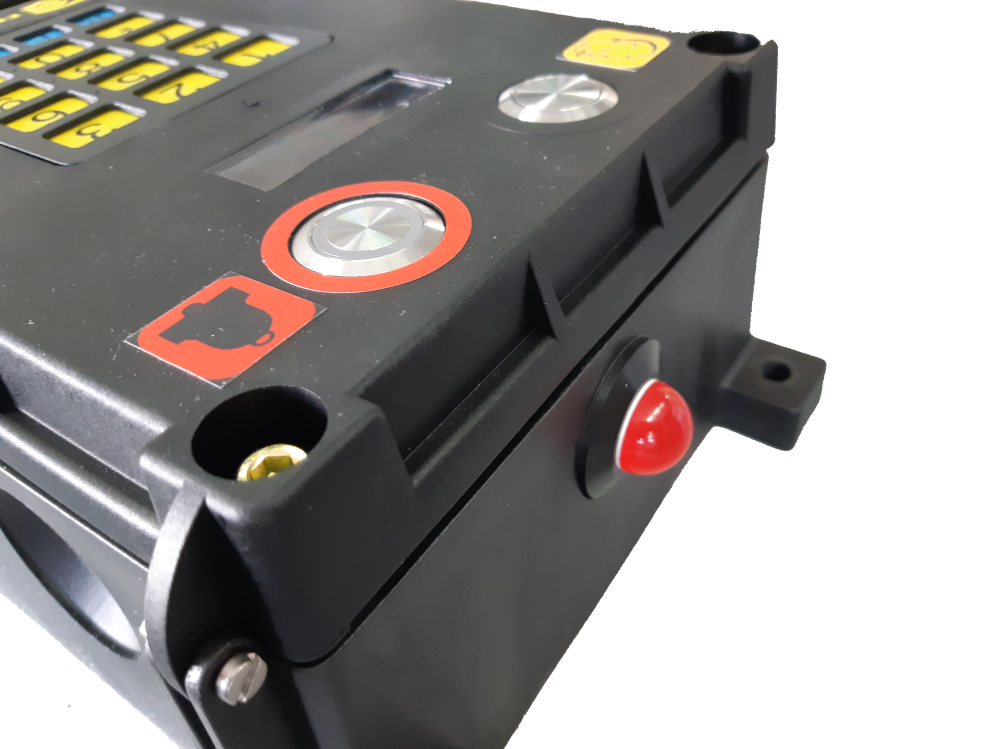
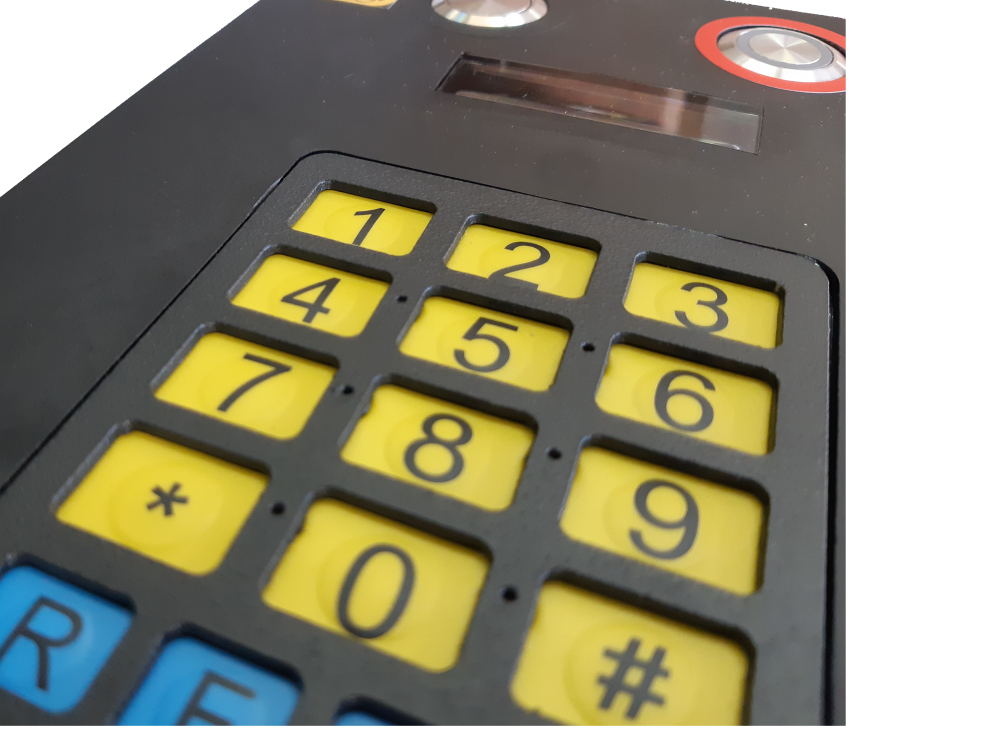
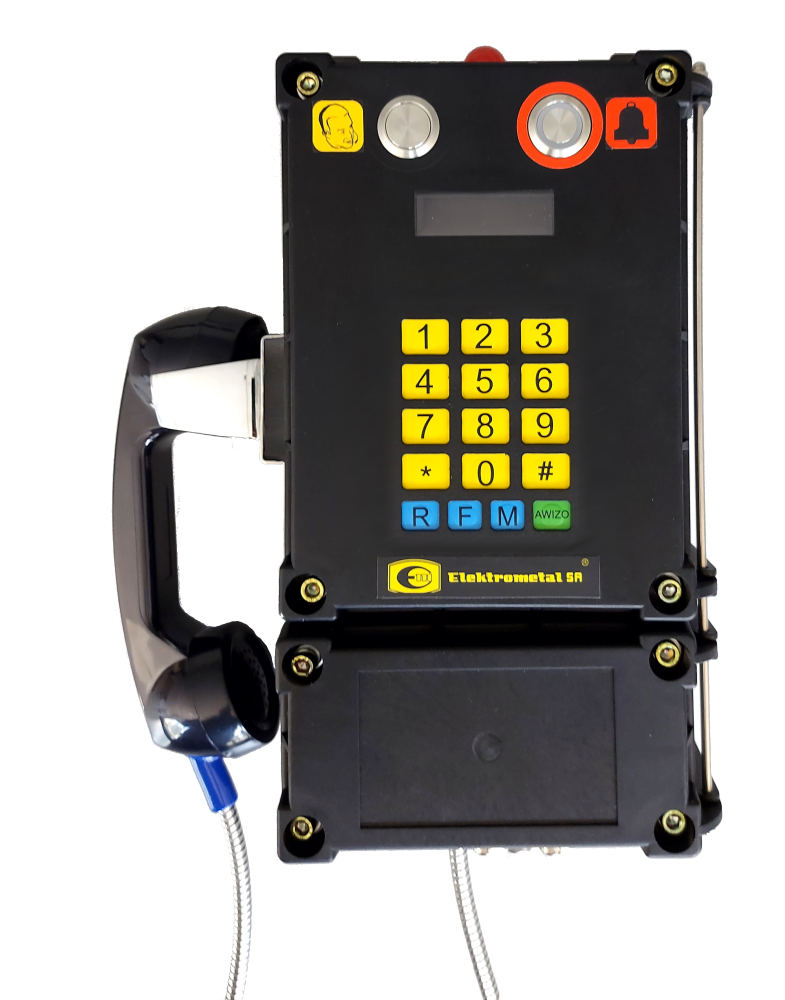
The device is equipped with a 16-button foil keypad with high mechanical durability and two large metal buttons outside the keypad: an illuminated ALARM button (calls the dispatcher/driver in emergency mode) and an OPERATOR button (calls in regular mode). The incoming call signal is at least 90 dB at a distance of 1 m—audible even with machinery operating—and is supplemented by a 20 mm diameter LED visible from a distance.
Technical data at a glance
| Parameter | Value |
|---|---|
| Degree of protection | IP65 |
| Operating temperature range | -40°C to +60°C |
| Permissible humidity (60°C) | 95% |
| Call signal | min. 90 dB / 1 m |
| Working range | up to 15 km |
| Input resistance | 800Ω ±25% |
| Input impedance | 600Ω ±25% |
| Frequency response | 300 Hz – 3400 Hz |
| Mass | approx. 3.5 kg |
| Dimensions (height/width/thickness) | max. 395×260×120 mm |
| ATEX certificate (group I) | TEST 17 ATEX 0033X - I M1 Ex ia I Ma |
| ATEX certificate (group IIB/IIIC) | TEST 17 ATEX 0033X - II 2G Ex ia IIB T4 Gb / II 1D Ex ia IIIC T200°C Da |
| Certificates | CE (ATEX, EMC, RoHS II) |
Available versions: ATI for group I (mining, no. 205-00-101/2) and ATI for group II (industrial, no. 205-00-101/3).
The manufacturer and supplier of the ATI device is Elektrometal SA of Cieszyn. We offer technical support, advice on product selection, and 24/7 service.
Contact us or call: +48 33 857 54 61
What is the difference between mining (gr. I) and industrial (gr. IIB/IIIC)? The Group I version (I M1 Ex ia I Ma) is intended exclusively for underground mines, including those with any methane hazard. The Group IIB/IIIC version (II 2G Ex ia IIB T4 Gb / II 1D Ex ia IIIC T200°C Da) is intended for industrial zones: Zone 1 for flammable gases and liquid vapors (e.g., fuel depots, refineries, paint shops) and Zone 20 for flammable dust. Both versions have the same TEST 17 ATEX 0033X certificate number, but different markings and intrinsically safe parameters – the choice of version depends on the hazard zone classification in a given facility.
Can ATI operate at fuel depots and refineries? Yes — the Group IIB/IIIC version is certified for areas exposed to flammable gas and liquid vapor mixtures with air (EPL Gb, subgroup IIB, category 2G, zone 1). This includes fuel depots, petroleum product bottling plants, LNG terminals, petrochemical installations, as well as paint shops and other facilities with the presence of flammable liquid vapors. For Zone 20 (combustible dust), the device has the IIIC category 1D feature.
How far from the control panel can the camera be mounted? For group I (I M1 Ex ia I Ma), the ATI can operate up to 15 km from the control panel (for a cable with parameters R≥50 Ω/km, L≤1 mH/km, C≤100 nF/km). For a typical cable with a resistance of 70 Ω/km, the range is up to 10 km. For industrial applications, this distance is slightly shorter. The device must always be connected through an intrinsically safe BSI separation barrier — direct connection to the control panel, bypassing the barrier, is not permitted.
How many numbers can be programmed into the phone's memory? The handset allows you to store 17 speed dial numbers in non-volatile memory: on the M+0 to M+9, M+*, M+#, M+F, M+R keys, and on the ALARM, OPERATOR, and A buttons. Additionally, you can program an automatic dialing number when you lift the handset (Speed Dial No.) with an adjustable waiting time of 0–10 seconds. Programming is performed using the keypad without having to open the case.
Is the call signal loud enough when the machinery is noisy? The device emits a minimum 90 dB audible signal from a distance of 1 m (Group I design). It is complemented by a 20 mm diameter LED, visible from a distance and flashing approximately every 6 seconds during normal operation, making it easier to locate the device in the dark or in high noise environments. The illuminated ALARM button flashes to indicate a lack of communication with the control panel.
What maintenance is required for an ATI device? Inspections are divided into ongoing (conducted on an ongoing basis by users), periodic (quarterly, performed by a maintenance technician), and essential (annual, performed by the manufacturer or an authorized entity). Inspections include a visual inspection of the housing, glands, keypad, indicators, and handset, as well as functional tests of the communication system. Repairs beyond replacing the handset and gland can only be performed by Elektrometal SA service.